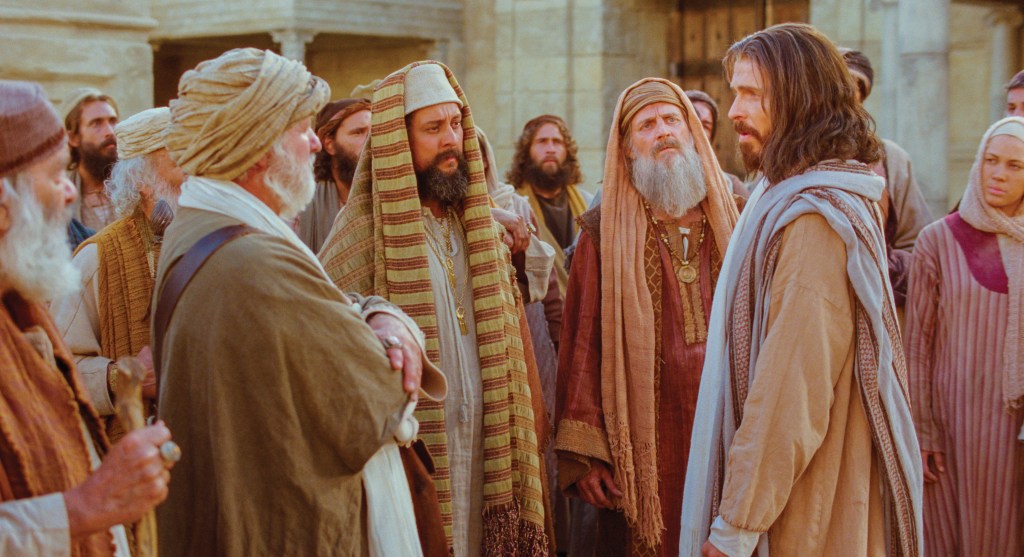
Scripture: On the last day of the feast, the great day, Jesus stood up and cried out, “If anyone thirsts, let him come to me and drink. Whoever believes in me, as the Scripture has said, Out of his heart will flow rivers of living water.'” Now this he said about the Spirit, whom those who believed in him were to receive, for as yet the Spirit had not been given, because Jesus was not yet glorified.
When they heard these words, some of the people said, “This really is the Prophet.” Others said, “This is the Christ.” But some said, “Is the Christ to come from Galilee? Has not the Scripture said that the Christ comes from the offspring of David, and comes from Bethlehem, the village where David was?” So there was a division among the people over him. Some of them wanted to arrest him, but no one laid hands on him.
The officers then came to the chief priests and Pharisees, who said to them, “Why did you not bring him?” The officers answered, “No one ever spoke like this man!” The Pharisees answered them, “Have you also been deceived? Have any of the authorities or the Pharisees believed in him? But this crowd that does not know the law is accursed.” Nicodemus, who had gone to him before, and who was one of them, said to them, “Does our law judge a man without first giving him a hearing and learning what he does?” They replied, “Are you from Galilee too? Search and see that no prophet arises from Galilee.”
John 7:37-52 ESV
[Click here to read the entire chapter.]
Observation: Recapping yesterday’s Daily Focus, at the midpoint of the feast, Jesus teaches amid the crowd, and those listening are amazed at this supposed unlearned man. Discerning their thoughts, Jesus explains that his teaching comes from God, but only those who seek God’s will know whether Jesus’ teaching comes from the Father.
As the dialogue heats up, some accuse Jesus of being demon-possessed. Still, many believe in him based on the extent of his miraculous signs that qualify him as the Christ. Then, overhearing the crowd’s comments, the chief priests and Pharisees sent for the temple guards to arrest Jesus. Discerning their thoughts, Jesus declares that he will not be around for long and will return to the One who sent him. So even though they will seek him, they will not find him. Taking his point literally, they question whether he will go to the Dispersion (i.e., those Jews who go and live abroad to convert Gentiles to the Hebrew faith).
Today’s devotion concludes the drama between Jesus and the religious leaders at this Feast of the Tabernacles. On the last day, Jesus declares aloud similar words of messianic identification spoken to the Samaritan woman (4:10-15): he is living water, flowing through us, quenching our thirst. Here, though, John explains the fulfillment of this metaphor: the gift of the Holy Spirit after Jesus’ glorification (i.e., at Pentecost). Such gracious words stirred the crowd, spurring some to propose he is the Prophet or the Christ. Still, others questioned such a claim, given that the Messiah must come forth from Bethlehem (see Micah 5:2), thus showing their ignorance of Jesus’ birthplace.
So, again, division erupted among the crowd. This time, officers (temple guards) are present, but rather than arrest Jesus, they report to their religious authorities all that transpired. Irritated, the chief priests and Pharisees question why they did not follow orders. In defense, the officers contend that Jesus spoke like no other person. Disgusted, the religious leaders question their officers’ discernment, note that none of the authorities believe Jesus is the Messiah, and arrogantly pronounce the crowd accursed for their ignorance of the law.
At this point, Nicodemus, one of the leading Pharisees, reappears in John’s Gospel narrative (introduced in Chapter 3) and graciously questions the legality of judging a man without first granting him a hearing. But those set on destroying Jesus condescend with a sarcastic question of whether Nicodemus is from Galilee, and then tell him to research and learn that no prophet arises from Galilee.
Takeaway: There are several ironic subplots in this passage. First, the crowds and the religious leaders show their ignorance despite the religious leaders supposing themselves to be superior in knowledge. Based on Jesus’ accent and the widespread reports that he hails from Nazareth, all assume that this backwater town is Jesus’ birthplace.
Secondly, the temple guards, dispatched by their closed-minded authorities to arrest Jesus, return empty-handed because they are open to hearing the truth.
Third, Nicodemus’ colleagues, who claim to uphold the law (by seeking to arrest and execute Jesus as a supposed blasphemer), unhesitantly will violate it to suit their agenda (i.e., judging and condemning him without a hearing).
Finally, despite all the wrangling and scheming of the authorities, because it is not Jesus’ time to face his arrest and crucifixion (see 7:6-8), he walks away undisturbed by the fomenting fear and anger that drives the religious leaders to make hasty decisions that will ultimately bring about their demise but serve God’s purposes to reconcile the humble and oppressed to him.
Our takeaway? There are two. Of secondary focus, we must resist judging a book by its cover. Those who assumed Jesus’ accent disqualified him as being the Christ will make the most egregious mistake of their mortal lives. They will reject words of truth that bring eternal life. It’s a cautionary story that warns us not to judge others based on their outward presentation. Even though they may not talk and act like us, we must resist dismissing their words for the risk of missing Christ speaking through them to us, even if they appear to be immature Christians.
That said, the primary focus of this passage is humility or the lack thereof. Humility undergirds our regeneration and sanctification. Indeed, we see a juxtaposition of pride and humility amid the crowd, the temple guards, and the religious leaders. The religious leaders and a segment of the crowd reveal how pride breeds closed-mindedness and contempt. In contrast, the guards exhibited humility that spurred open-mindedness and hope. Also, we see how education does not equate to godly wisdom and understanding. For all their machinations, the erudite religious authorities remained one step behind Jesus until his appointed time.
Our part? It is no different for us. Knowledge without humility will fail us. Solomon’s sad ending to life is an exclamation mark on this point, for no amount of education or worldly wisdom could save him from his prideful fall. That’s why Jesus emphasized that we must have the faith and humility of a child (Matthew 18:2-4) and that we must be as innocent as doves but as wise as serpents (Matthew 10:16). The antithesis is self-reliance and judgmentalism, both of which are born in pride. That said, we are all guilty of becoming consumed in self-importance and judging others based on outward appearances. Thankfully, if we exercise humility, the Holy Spirit will quicken our consciences, spur us to repent, strengthen our trust in our Savior, and realign us to the Father’s good, pleasing, and perfect will (Romans 12:2).
Prayer: Father God, we thank you for the gift of your Son, who humbled himself by taking on human form and incurring the insults and rage of arrogant and prideful people to ensure we would not face your wrath for our pride and judgmentalism. So, in your mercy, please help us to cooperate with your Holy Spirit in submitting to his sanctifying work in our lives so that we might exercise humility in our interactions with you and others. Amen.
Rev. Gordon Green, M.Div., M.A. Counseling


Leave a Reply